Plugin Architecture
spyre-inference is a vLLM out-of-tree (OOT) platform plugin that enables inference on
IBM's Spyre AI accelerator. It integrates with vLLM's plugin system to replace key
compute layers with Spyre-optimized implementations while preserving the rest of the
vLLM execution pipeline.
System Overview
The diagram below shows how spyre-inference fits into vLLM's process architecture.
Blue boxes are Spyre-specific classes provided by this plugin; dark boxes are vLLM base
classes; the gold box is the model loaded from vLLM's model registry with Spyre custom
ops injected via OOT registration.
The plugin registers via two entry points:
| Entry Point | Target | Purpose |
|---|---|---|
vllm.platform_plugins |
spyre_inference:register |
Registers TorchSpyrePlatform — sets dtype, worker class, attention backend, and distributed backend |
vllm.general_plugins |
spyre_inference:register_ops |
Calls register_all() — importing the ops package triggers every @register_oot() layer swap, and register_all() additionally registers the spyre_convert custom op (RoPE registers no op — its rotation runs in-graph). Also overrides vLLM's TransformersForCausalLM with SpyreTransformersForCausalLM |
vLLM is built from source with VLLM_TARGET_DEVICE=empty (no device-specific C
kernels), so the platform overrides a few CPU-backend assumptions: import_kernels() is
a no-op (there is no vllm._C), and the model runner reimplements the slot-mapping
kernel in pure PyTorch.
Component view of a Granite model
Custom Op Replacement
Most layers that require Spyre-specific handling are replaced via vLLM's
@ClassName.register_oot() decorator (a few, like SiluAndMul, need no replacement and
run upstream in the compiled graph). Most replacements are pure class swaps that run
when the ops package is imported. register_all() additionally registers the spyre_convert
custom op — the convert helper keeps device transfers invisible to torch.compile.
RoPE registers no op — its rotation-cache gather and 2×2 rotation run directly in the
compiled graph (see below).
| vLLM Layer | Spyre Replacement | Device | Notes |
|---|---|---|---|
GemmaRMSNorm |
SpyreGemmaRMSNorm |
Spyre | An fp16 body with no dtype promotion. Plain RMSNorm needs no replacement — upstream's fp32 forward_native lowers — but Gemma's trailing fp32 weight multiply does not: a STANDARD [hidden] operand that torch-spyre can neither broadcast against a staggered-EA activation nor de-stagger. |
RotaryEmbedding, Llama3RotaryEmbedding |
SpyreRotaryEmbedding, SpyreLlama3RotaryEmbedding |
Spyre | Fully on-device, no opaque op. A device-resident 4D rotation cache ([max_pos, 2, 2, rotary_dim//2]) is built from cos_sin_cache and primed on-device in _apply before torch.compile; forward_oot then gathers this pass's per-token slice with index_select and applies the 2×2 rotation-matrix formulation (_rotate_neox_2x2) — both traced directly into the full-model compile graph. Priming before compile is the requirement: building the cache lazily inside the traced forward segfaults libsenlib during warmup, whereas a cache already materialized on-device indexes cleanly. Only neox-style full rotary is supported — other configs raise NotImplementedError at construction. The 2×2 inner dim rotary_dim//2 must also be stick-aligned; this is not re-checked but is guaranteed by head-dim padding (see below) |
VocabParallelEmbedding |
SpyreVocabParallelEmbedding |
Spyre (TP tables built on CPU at load) | The weight moves to Spyre with the model and the embedding gather runs on-device (aten.embedding now has a Spyre kernel, torch-spyre#420). TP=1 gathers directly. When TP>1, the per-vocab reindex/keep tables are built once on CPU at load and registered as device buffers; forward derives masked_input/keep from them on-device (index_select/F.embedding), applies the keep mask, and all_reduces — no per-step CPU round-trip |
ColumnParallelLinear, MergedColumnParallelLinear, QKVParallelLinear, RowParallelLinear, ReplicatedLinear |
SpyreColumnParallelLinear, SpyreMergedColumnParallelLinear, SpyreQKVParallelLinear, SpyreRowParallelLinear, SpyreReplicatedLinear |
Spyre | All five swap in SpyreUnquantizedLinearMethod (the transposed-weight fast path below). SpyreQKVParallelLinear additionally asserts gather_output=False; SpyreRowParallelLinear (o_proj, down_proj) inherits upstream's all_reduce when reduce_results=True under TP>1 |
SiluAndMul |
— (not replaced) | Spyre | No OOT class: vLLM's own SiluAndMul is traced into the compiled graph, so silu(gate)·up runs on Spyre and slices the fused [..., 2*d] on-device. The Spyre-specific piece is mlp_pad.py, which zero-pads intermediate_size to the 64-element stick at load time so that slice lands at a lowerable offset (inert since silu(0) = 0) |
NewGELU |
— (not replaced) | Spyre | No OOT class: vLLM's own gelu_new is traced into the compiled graph, cube term included — torch-spyre decomposes its torch.pow(x, 3.0) into a chain of mul ops (torch-spyre#4479) |
ParallelLMHead |
SpyreParallelLMHead |
Spyre | TP≥1 with vocab sharding; per-rank weight padded to a multiple of 64×32 and pre-transposed; apply runs x @ Wᵀ then the un-pad slice, on Spyre — eager, no CPU detour; logits stay on Spyre for the TP all_gather |
LogitsProcessor |
SpyreLogitsProcessor |
Spyre → CPU | Moves logits to CPU so all downstream sampling runs on the host. _apply_head D2Hs on the single-card path; when TP>1 _gather_logits runs the all_gather on Spyre and then converts the result. Either way the sampler's logits.to(torch.float32) never runs on Spyre, where it would crash torch-spyre's copy_from_d2d |
GateLinear |
SpyreGateLinear |
Spyre | Clears out_dtype so MoE router logits stay in the weight dtype because Spyre cannot restickify fp32 (spyre::ReStickifyOpHBM is unsupported for IEEE_FP32). The MoE backend promotes stick-aligned full-softmax reductions to fp32 and returns them to the transport dtype |
Transposed linear weights
F.linear(x, W) computes x @ Wᵀ however W is laid out, and on Spyre that transposed
matmul is ~3.5× slower than a plain x @ A
(torch-spyre#3512).
SpyreTransposedWeightMethod (custom_ops/linear.py) is the shared base that closes that gap
in two overrides:
process_weights_after_loadingreplaces the loaded[out, in]weight with a contiguous[in, out]Wᵀ(optionally padding the output rows first), so the transpose is paid once at load time rather than every forward.applyrunsspyre_linear_t—torch.matmul(x, Wᵀ)plus optional bias — instead ofF.linear, dropping any trailing pad columns with an eager on-device un-pad slice.
SpyreUnquantizedLinearMethod uses the base defaults (transpose in place, no padding); the five
linear subclasses install it in __init__, but only when quant_method is an
UnquantizedLinearMethod; quantized layers keep their own method and the slower
F.linear path. This is the pure-PyTorch equivalent of torch-spyre's [1,0] weight
layout, which only fires for nn.Linear and so misses every vLLM parallel-linear.
SpyreUnquantizedLMHeadMethod reuses the same base with WEIGHT_T_ATTR="padded_weight_t" and
ROW_ALIGN=64*32, so the fast path and the padding/un-pad logic are defined once.
Fused projections stay fused. SpyreQKVParallelLinear returns the whole [..., q+k+v]
tensor and the unmodified upstream idiom q, k, v = qkv.split(...) slices it, exactly as
SpyreMergedColumnParallelLinear's [..., 2*d] output feeds the upstream SiluAndMul,
which slices gate/up on-device. Earlier revisions instead split the QKV weight on CPU at load
time into three per-part GEMMs — a SplitQKV container built by an analyze_and_unfuse
pass — so that no fused output ever had to be sliced; one fused GEMM is faster than three,
so that pass is gone. The remaining slicing constraint is narrower than it was and lives
in the attention backend, where offset > 0 views still corrupt on transfer (see
Attention Backend).
Model adaptations
Some models need more than a swapped-out layer: a different transport for an input, a buffer
that has to follow .to("spyre"), an expert dispatch Spyre can lower. Those live in
spyre_inference/models/, one module per architecture, as subclasses of the upstream vLLM
class rather than runtime monkey-patches. models/__init__.py holds spyre_models()
(architecture string → Spyre class, built from the _ADAPTED_MODULES and _ADAPTED_ARCHS
tables) and register_models(), which points vLLM's ModelRegistry at them; _-prefixed
modules hold machinery those subclasses share or delegate to and register no architecture of
their own. Registration is lazy — nothing is imported until vLLM resolves the architecture —
and register_models() first checks every key against vLLM's own registry, so an upstream
rename fails loudly instead of silently falling through to the unadapted class.
Where upstream hardcodes a class and offers no hook (the BERT wrappers hardcode
embedding_class), the already-built instance is retyped to its Spyre subclass — same
__init__, same parameters, same module tree, only forward differs. Prefer a documented
upstream extension point where one exists: CustomOp.register_oot /
PluggableLayer.register_oot for a layer, and — for a MoE — the quant-method seam the
unquantized oracle leaves open for an out-of-tree platform.
Two adaptations worth knowing:
- BERT / RoBERTa (
models/_token_type.py) carrytoken_type_idsin a side buffer owned by the embedding instead of vLLM's bit-pack into the high bits ofinput_ids, which Spyre cannot unpack (torch-spyre#3509). - MoE (
moe.py) supplies the routed-expert backend vLLM's unquantized MoE oracle lacks for an out-of-tree platform (it selectsUnquantizedMoeBackend.OOT— no kernel — and leavesprocess_weights_after_loadingto the plugin). ACustomOp.register_ootreplacement forUnquantizedFusedMoEMethodcomputes the experts in two Spyre forms — gathered for a single-token decode step, all-expert persistent for a prefill chunk — and, in the post-load hook, rebuilds each layer'sw13 [E,2M,H]/w2 [E,H,M]stacks into the[E,H,M]/[E,M,H]layout those forms contract on, freeing each source stack as it goes, since the device cannot hold both layouts at once. Tensor parallelism needs nothing further: upstream shards each expert's intermediate dim, so the forms just see a narrowerM— zero-widened to whole sticks where a shard lands mid-stick — andMoERunnerall-reduces the per-rank partial sums. Each model's own adaptation module supplies its recipe and any model-owned scaling (configure_gemma4_moe_layersinmodels/gemma4.py).Gemma4DecoderLayer.forwardandMoERunnerare untouched: vLLM reaches the experts throughtorch.ops.vllm.moe_forward, an opaque custom op, so the dispatch runs eagerly inside the block's compiled graph — the same seam the attention backend uses — and can drive compiled regions of its own.
Compilation Granularity
Under CompilationMode.STOCK_TORCH_COMPILE, _compile_for_spyre compiles each entry of
the model's block ModuleList in place via block.compile(backend="inductor",
fullgraph=True, dynamic=False). In place matters: rebinding the list entry to the
OptimizedModule that torch.compile returns would re-parent the block under an
_orig_mod child and rename every parameter, breaking weight save/reload.
Every graph is compiled dynamic=False because torch-spyre's Inductor backend rejects
SymInt shapes: a compiled graph is specialized to one concrete input shape. This is the
root reason the plugin buckets shapes everywhere — variable request shapes are padded up
to a small fixed set of compiled shapes (the padding masked out), and warmup pre-compiles
every reachable bucket so no request pays an Inductor compile mid-serving. Two shape axes
are bucketed independently: the packed num_tokens for the block graph (below) and
(num_blocks, query_len) for attention (see Attention Backend).
Blocks are found structurally — a ModuleList whose non-PPMissingLayer entries own an
Attention somewhere, and are not themselves Attention layers — so decoder stacks
(model.layers) and encoder stacks (bert.encoder.layer) are both covered, as are
hybrid Mamba+attention stacks that mix layer classes in one list. A ModuleList of bare
Attention layers (Zamba2's shared dpa_list) is skipped: it is not a block stack.
Models whose attention is not a vLLM Attention — MLA (DeepSeek, Kimi), vision-tower
attention — match nothing and fall back to a whole-model graph.
Blocks of one class share one forward code object, so Dynamo traces the first and the
rest reuse that entry; whatever it re-traces hits the Inductor FX graph cache. The
backend compile count is independent of depth, but it is not 1: layer 0 specializes
separately because residual is None there, so a Llama-shaped stack yields two
artifacts, and stacks that vary per layer yield more — Gemma 3 alternates sliding-window
and full attention, giving four. A fresh num_tokens bucket then costs one block recompile
rather than a whole-model one. Note that num_tokens is the block graph's only shape
dependence: kv-cache length and its block-count buckets live inside
unified_attention_with_output, which is opaque to this graph and compiles its own
kernels (see Kineto profiling).
Depth independence relies on vLLM hoisting the per-layer attention name out of the graph,
which needs torch >= 2.11 and VLLM_USE_LAYERNAME=1. Without it each block bakes in its
own layer name and compiles separately, which is worse than the whole-model graph; the
runner logs a warning when it detects this. Inductor freezing (enabled by max_autotune)
defeats sharing the same way, by folding each block's weights into its own graph.
Embeddings and the final norm sit outside the block list and stay eager. lm_head was
never in the compiled region; compute_logits is a separate call on the wrapper.
SPYRE_COMPILE_GRANULARITY=model restores the whole-model fullgraph, whose compile cost
grows with layer count.
Attention Backend
The SpyreAttentionBackend implements paged attention using pure PyTorch operations
(no custom CUDA kernels). The KV cache is one dense tensor per layer on Spyre,
[num_blocks, block_size, num_kv_heads, head_size] — the shape
SpyreAttentionBackend.get_kv_cache_shape advertises. It runs a FlashAttention-style
online softmax that iterates over pages without any compact-gather step, reading each
page by indexing the dense tensor with a one-element int32 device tensor (an indirect
access, so the compiled bundle carries a real index rather than a constant slice) and
permuting the token-major page to head-major on device before the matmuls. The cache is
allocated with the slot axis outermost in the device layout (slot_major_kv_layout) so
the write can scatter through a slot-major view of it:
| Step | Device | Operation |
|---|---|---|
| 1. Build metadata & masks | CPU → Spyre | The metadata builder reads query_start_loc/seq_lens, pads each query_len and KV block count onto their buckets, builds the per-sequence query-row index tables and the additive mask on CPU, then copies them to the device |
| 2. Write new K/V to cache | Spyre | Compiled index_copy_ scatter through a slot-major view of the paged cache (one per tensor, fused); only the slot-index vector is computed host-side and copied over |
| 3. Per-sequence page attention | Spyre | A host-driven loop dispatches one compiled kernel per sequence — the query rows are gathered on-device (never copied to CPU): Q @ Kᵀ · scale → optional soft-cap → + tile_mask → online softmax → @ V |
| 4. Write-back | Spyre | Each sequence's result is written into the Spyre output buffer with a device-to-device copy |
The compiled kernels themselves — the per-sequence page attention, the batched decode
path, the KV store, and the cache's device layout — live under
spyre_inference/v1/attention/ops/; the backend module holds the metadata builder and
the host-side orchestration that calls them.
Because attention kernels are dynamic=False too, they are pre-compiled during warmup
rather than lazily on first use: by default (SPYRE_ATTN_RECORD=1) warmup traces every
variant SpyreAttnBucketer can produce — the product of the KV-length and query-length
buckets below — so a served request always lands on an already-compiled kernel. When the
batched-decode kernel is enabled (SPYRE_BATCHED_DECODE=1, the default) warmup also
records its variants, the product of the KV-length (num_blocks) and num-sequences
buckets. A single step can carry a mix of prefill and decode sequences; each sequence is
padded to its own query bucket (decodes use the length-1 bucket) before dispatch.
SPYRE_ATTN_RECORD=0 restores lazy per-variant compilation.
Head-major KV cache
SPYRE_ATTN_KV_LAYOUT=head_major selects a second backend,
SpyreHeadMajorAttentionBackend, that stores a page as
[num_blocks, num_kv_heads, block_size, head_size] instead. The page then arrives in the
shape the matmuls want, so the per-page permute in step 3 disappears — that is the whole
point of the layout. It moves the transpose to the write: a token's KV heads are
block_size rows apart, so step 2 becomes one index_copy_ per KV head (kv_write_index
publishes one index per head) over a source materialized contiguously first, rather than a
single store of one contiguous run per token.
Everything above the cache's memory — the metadata builder, the bucketer, the mask tiles,
warmup recording and dispatch — is shared with the token-major backend. What differs is
duplicated rather than parameterised: the advertised shape, the allocation
(head_major_kv_layout), and the three kernels that touch a page. The worker follows the
layer's impl (allocate_pages) rather than a hardcoded shape, so the two cannot disagree.
LX-resident pages
The head-major per-sequence kernel keeps a gathered page in the LX scratchpad from its
gather to its last use instead of round-tripping through HBM. Two shape choices get it
there. The page is gathered on (page, kv_head) with a [num_kv_heads, 1] index, so the
gather's split lands per KV head — an output axis of probs @ V the consumer can mirror;
behind a 1-D index the entry axis instead splits in whole 32-entry sticks. And the query
groups fold into the query's row axis — a reshape, since heads are KV-major — so each
matmul carries a single batch dim: the batched GQA form leaves the page with two batch dims
and Inductor clones it out to a query-group axis it does not have (torch-spyre#4123). The
cache fold is free too — [num_blocks, KV, block_size, D] reshapes to
[num_blocks * KV, block_size, D] — but the cache is allocated with that folded axis at
device dim 0, which is where an indexed axis has to sit for the gather to cost one page
rather than the whole tensor.
Three things follow from those choices. The gather is a 2-D subscript, which lowers to
aten.index and fails eager by upcasting its int32 index, so this backend always compiles
attention even under --enforce-eager — attention compiles in its own domain, so the rest
of the model still runs eager. Because the bmm's output axes
(num_kv_heads * padded_query_len) cannot fill 32 cores at decode, and filling them would
mean K-splitting a reduction a gather cannot mirror, the attention compile alone is capped
at 8 cores; SPYRE_ATTN_MAX_CORES overrides that. And the layout carries neither ALiBi
(which needs a bias tile per query group) nor batched decode (whose kernel gathers whole
pages from the unfolded cache) — both are available on the token-major layout.
Residency is a property of the layout plan, not of a result, so it is measured off the
planner's own verdicts by scripts/probes/lx_head_major_residency.py. K's residency
needs torch-spyre#4153: q @ Kᵀ lowers the transpose to a restickify, whose cross-frame
barrier bars an LX-resident input without that PR's local-read proof. V is read directly
by probs @ V and stays resident either way.
Key constraints:
- KV length bucketing: padded block count on power-of-two buckets from
block_sizetomax_model_len(avoids per-step recompilation on Spyre) - Query length bucketing:
[1] + multiples of min(512, max_num_batched_tokens)(consistent tensor shapes for compilation) - Num-sequences bucketing (batched-decode kernel only,
SPYRE_BATCHED_DECODE=1, the default; not on the head-major layout): powers of two from 4 tomax_num_seqs(SPYRE_ATTN_NUM_SEQS_BUCKETS); the decode-batch kernel is recorded over the(num_blocks, num_seqs)grid - Head size: Must be a multiple of 64 (128-byte Spyre stick ÷ 2-byte float16)
- Block size: Must be a multiple of 64. The default is 128, and a user-supplied
block_sizeis rounded up to the next multiple of 64 - GQA only: MHA (
num_queries_per_kv = 1) currently fails in the Spyre compiler's layout-propagation pass; only GQA configurations are exercised today - Supported: sliding-window masking (per layer, so a hybrid stack's full-attention layers stay unwindowed) and logits soft-capping are both handled; ALiBi slopes are not
Encoder-only attention
Encoder-only (embedding) models take a separate path. For ENCODER/ENCODER_ONLY
layers, TorchSpyrePlatform.get_attn_backend_cls selects SpyreEncoderAttentionBackend
→ SpyreEncoderAttentionImpl (both subclass the decoder backend/impl in
spyre_encoder_attn.py). This path has no KV cache — attention is bidirectional over
the full sequence — so it skips the paged-cache machinery entirely and instead:
- Builds the pack indices and the additive mask on CPU (Spyre can't produce the bool
mask or broadcast the
where), then scatters ragged Q/K/V into the dense[num_seqs, H, L, Dp]batch on Spyre with a compiledindex_copy_. Sequence lengthLpadding to theENCODER_SEQ_ALIGNMENT = 64stick is structural (the zero rows of the on-device workspace); head dimDis padded to the stick only when it isn't already aligned — a hostF.padround-trip for MiniLM'shead_size=32, a no-op forD=64. - Runs the attention on Spyre: a fused
F.scaled_dot_product_attentionon the B=1, no-live-pad path, or — on the additive-mask path — a compiled QK matmul, an on-device (eager) mask add, and a compiled P·V. The matmuls are kept separate so Inductor can't fuse them intoF.sdpa, which drops the additive mask on Spyre. - Unpacks with an on-Spyre
index_selectand writes back withoutput.copy_on Spyre. A CPU round-trip remains only for non-stick-aligned head dims (MiniLMD=32), which sliceDback on the host.
Encoder / embedding models: target state
Everything above describes what is implemented today. The diagram below is a target state — where the encoder path is heading once the compile-mode work lands, and not a description of current behaviour.
The shape of that target: the model body compiled once per token bucket, attention shape-managed separately behind the opaque custom-op boundary, and a warmup that walks both sets of shape buckets so nothing compiles on the first request.
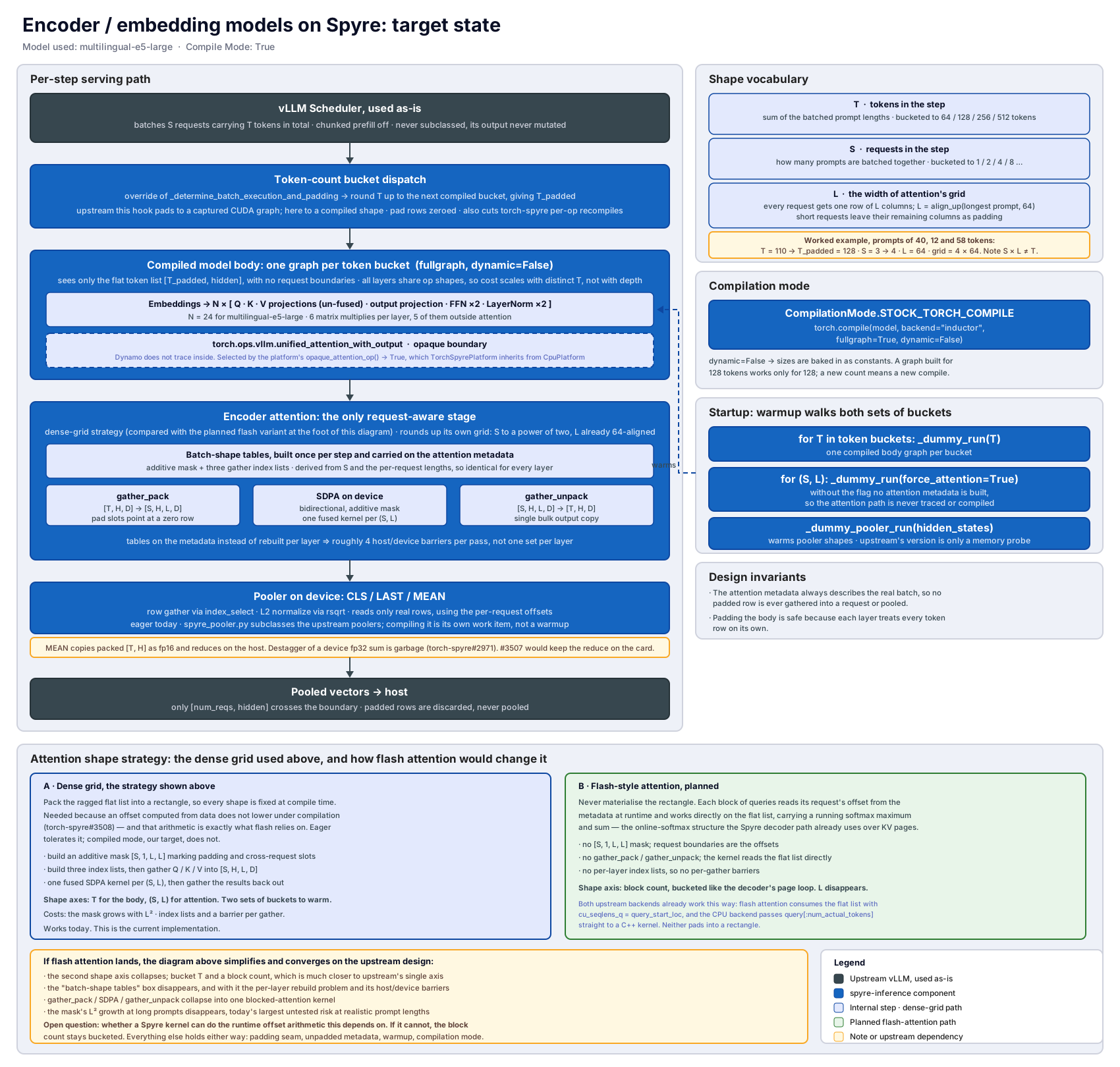
STOCK_TORCH_COMPILE. Two shape axes are bucketed independently: the
token count T for the model body, and (S, L) for
attention's dense grid — they are decoupled because attention builds its grid by
gathering rows rather than by being handed a reshaped tensor. The foot of the
diagram contrasts today's dense-grid strategy with the planned flash-style variant,
which would collapse the second axis and converge on the upstream design.
Device Placement Strategy
TorchSpyreModelRunner inherits from vLLM's GPUModelRunner and treats Spyre as the
"GPU" in the CpuGpuBuffer pattern. Buffers are created via a SpyreCpuGpuBuffer
override:
- Float dtypes:
.cpuon CPU (numpy staging for the scheduler),.gpuon Spyre asfloat16 - Int / bool dtypes:
.gpualiased to.cpu(Spyre doesn't natively support these)
self.device stays cpu so that scatter, indexing, and block-table ops run on CPU, but
float compute tensors land on Spyre via self._spyre_device. Because there is no
vllm._C under VLLM_TARGET_DEVICE=empty, the runner also swaps in a pure-PyTorch
_compute_slot_mapping implementation for the paged-cache slot mapping.
At load time, load_model moves every module except Attention scale buffers onto Spyre.
The weight transposes happen before that, in each layer's
process_weights_after_loading, while the weights are still on CPU.
_SpyreModelWrapper sits between the model runner and the model and converts at the
call boundary:
- Input: CPU
int32/int64tensors → Spyreint64(for embedding lookup) - Output: Spyre
float16tensors → CPU (for logits indexing and sampling) compute_logits: moves the CPU-slicedhidden_states[logits_indices]back onto Spyre for theSpyreParallelLMHeadmatmul, which returns logits on Spyre
SpyreVocabParallelEmbedding inherits weight loading and shard arithmetic from upstream
and overrides forward. The weight moves to Spyre with the rest of the model, and the
embedding gather runs on-device now that aten.embedding has a Spyre kernel
(torch-spyre#420) — this
replaces the earlier silent D2H/H2D CPU fallback that copied the full [vocab, hidden]
weight on every decode step. When TP>1 the shard mask is applied on-device:
get_masked_input_and_mask runs once at load to build per-vocab reindex/keep lookup
tables (its int64 comparisons against Python constants cannot lower on Spyre), registered
as device buffers; forward then gathers through them with index_select/F.embedding,
applies the keep mask, and all_reduces — all on Spyre, no per-step CPU round-trip.
Hidden states flow on Spyre between decoder layers, with CPU round-trips only for work that stays host-side: logits indexing for sampling, and the attention metadata the builder prepares on CPU (slot mapping, the per-sequence index tables and additive mask). The per-sequence attention loop is host-driven control flow, but its query-row gather and kernels run on Spyre; the KV-cache write and the write-back are device-to-device. RoPE's rotation-cache gather and the embedding gather also run on-device.
Transformers backend
When model_impl="transformers", register_ops swaps vLLM's TransformersForCausalLM
for SpyreTransformersForCausalLM (spyre_inference/transformers_backend.py). vLLM's
stock Transformers backend still handles model creation, weight loading, attention
routing, the KV cache, and scheduling, and its fusers replace HF's linear/norm/GLU
modules with vLLM layers — which the OOT registrations above then pick up automatically.
The subclass covers what upstream leaves to HF's module code. There is no RoPE fuser, so
HF's rotary_emb survives and would derive cos/sin inside the forward from int64
position_ids, a cast torch-spyre cannot lower. It is replaced with a precomputed
[max_model_len, 2, 2, head_dim/2] rotation cache — built on the host and moved to the
device before compile, leaving only an index_select in the graph — plus a matmul-based
apply_rotary_pos_emb. Head padding is shared with the native path: the platform widens
head_dim and the weight passes in head_pad.py pad Q/K interleaved, so this backend
only has to rebuild the rotation cache at the pre-pad frequencies.
RMSNorm registers no OOT op: upstream forward_native lowers its fp16→fp32 upcast
into the compiled graph. GemmaRMSNorm still needs one, because its trailing fp32
weight multiply hits a torch-spyre gap — a STANDARD [hidden] operand that can
neither broadcast against nor de-stagger the staggered-EA activation. Because the
fusers key on class names, the OOT registry covers the fused Gemma norm
(SpyreTPAwareGemmaRMSNorm) too.
Distributed (TP)
TorchSpyrePlatform.get_device_communicator_cls returns SpyreCommunicator, a
DeviceCommunicatorBase override in
spyre_inference/distributed/spyre_communicator.py. The installed libspyre_comms.so
now implements barrier, broadcast, send/recv, list-form allgather, gather,
and allreduce; only reduce remains a throw-stub, and torch-spyre's spyreccl
backend still stubs _allgather_base (so dist.all_gather_into_tensor doesn't work).
SpyreCommunicator therefore overrides:
all_reduce— uses the functional_c10d_functional.all_reduce, which torch-spyre lowers tospyre::all_reduce_asyncinside a compiled graph and which runs eagerly vialibspyre_commsoutside one, so one code path serves both modes.all_gather— inside a compiled graph the functional collective lowers tospyre::all_gather_asyncand stays on device; eager keeps native list-formdist.all_gather, because the functional entry point (allgather_into_tensor_coalesced) is rejected outside a graph. CPU tensors route through the gloo half of the multi-backendcpu:gloo,spyre:spyrecclgroup.reduce_scatter— raises; it is not on the TP forward path.
gather is not overridden — it works natively via libspyre_comms. The
tests/probes/test_spyre_comms_native_probes.py xfail-strict suite is the canonical
signal: when a probe flips green, delete the corresponding override or workaround.
The worker (TorchSpyreWorker) inherits directly from vLLM's Worker (gpu_worker), not
CPUWorker — Spyre needs none of the CPU-specific init (NUMA binding, host-RAM
profiling). Data parallelism (data_parallel_size > 1) is rejected in
check_and_update_config.